
In This Article
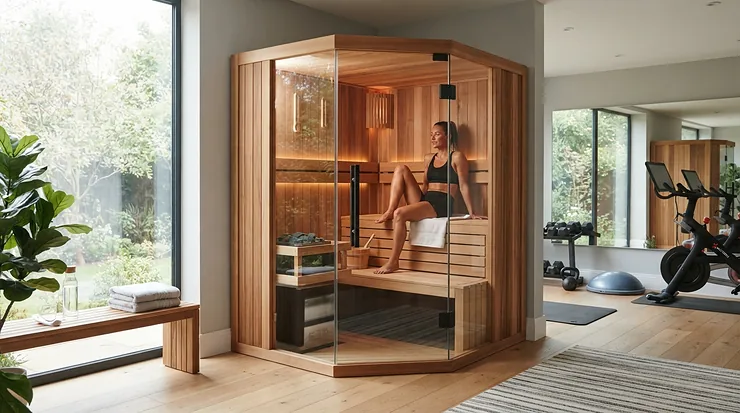
A full spectrum infrared sauna for muscle recovery is a cabin, tent, or blanket whose panels give off near, mid, and far infrared energy. It warms your body directly instead of heating the air around you. The usual aim is to use it after training to ease soreness, boost circulation, and help you feel ready for the next session sooner.

Picture the Monday after leg day. Stairs feel like a personal insult. That’s the moment people start browsing saunas at 11 p.m. and wondering if a heated box can really fix quads that feel like wet cement.
The honest answer is: partly, and with caveats. The research on a full spectrum infrared sauna for muscle recovery is encouraging, not magical. Wikipedia’s overview of the infrared sauna is blunt that some of the grander claims, such as curing cancer, are pseudoscience. The narrower claims about soreness, perceived recovery, and short-term power are another story. Small, well-run trials support them.
This guide sticks to that narrower, defensible ground. I haven’t personally tested any of these products. Everything below comes from published specs, manufacturer and retailer documentation, and peer-reviewed research. I explain what each spec means in practice, and I flag where evidence is thin. We’ll cover delayed onset muscle soreness, post workout inflammation, and how near and far infrared wavelengths differ. We’ll also see whether a full spectrum infrared sauna for athletes is worth the extra cost over a basic cabin.
Quick Comparison: 7 Full Spectrum Infrared Saunas for Muscle Recovery at a Glance
| Product | Format | Standout Trait | Best For |
|---|---|---|---|
| SaunaBox Pulse PRO | Portable sit-in tent | Integrated 660 nm + 850 nm LEDs | Renters and small spaces |
| Real Relax Full Spectrum Sauna | 1-person cabin | 7 panels, dual-wavelength red light | Budget-conscious solo users |
| ENSTVER Full Spectrum 1-Person Sauna | 1-person cabin | Hemlock build, 1240W | Solo lifters wanting a real cabin |
| SALUSHEAT Full Spectrum 3-Person Sauna | 3-person outdoor cabin | 1950W, reclining seats | Training partners and families |
| Finnmark FD-2 | 2-person cabin | 120V plug-in design | Couples wanting premium without rewiring |
| Sun Home Equinox 2 | 2-person cabin | App control, published EMF/VOC data | Data-minded daily users |
| HigherDose Full Spectrum Infrared Sauna | 2-person cabin | Design and smart controls | Premium home-gym setups |
The table sorts the field by lifestyle, not just wattage. If you rent, the SaunaBox Pulse PRO is the only genuinely apartment-friendly entry. For a first real cabin, Real Relax Full Spectrum Sauna and ENSTVER Full Spectrum 1-Person Sauna keep the cost down. The Finnmark FD-2, Sun Home Equinox 2, and HigherDose Full Spectrum Infrared Sauna are the “buy once, use for years” tier, priced to match.
💬 Just one click — help others make better buying decisions too!😊
Top 7 Full Spectrum Infrared Saunas for Muscle Recovery: Expert Analysis
Every entry below translates specs into real-world meaning, then flags what’s verified and what isn’t. Where I couldn’t confirm individual customer reviews, I say so instead of papering over the gap.
1. SaunaBox Pulse PRO — apartment-friendly tent with built-in red light
This portable sit-in tent exists for people who can’t bolt a wooden cabin into their lives. Its manufacturer lists a 160°F maximum, 1,600W panels, and 320 LEDs at 660 nm and 850 nm. Those wavelengths match what photobiomodulation research typically uses. Setup is quoted at about 15 minutes, which matters if you’re storing it between sessions.
The specs hold up better than the labeling does. Some comparison pages describe the panels as full spectrum, while others describe far infrared plus red light. Sources conflict, so treat “full spectrum” here as unconfirmed and check the current listing. Also note that the published comparisons come from the manufacturer itself.
Who’s it for? Renters, travelers, and anyone who wants heat plus targeted red light without a dedicated room. Sitting in a tent also limits how much of your body gets full-coverage panel exposure.
Reviewer sentiment: I couldn’t verify individual customer reviews for this unit, so check the current listing’s recent feedback before buying.
Pros:
- ✅ Fits apartments and folds away
- ✅ Includes 660 nm + 850 nm red light
- ✅ Quick setup compared with cabins
Cons:
- ❌ Spectrum claims vary between sources
- ❌ Seated tent limits full-body exposure
Price range: portable tents like this generally run from several hundred dollars to the low thousands (check current price). It’s strong value for flexibility, weaker value if you want a permanent ritual.

2. Real Relax Full Spectrum Sauna — budget cabin with dual-wavelength red light
This one packs a lot onto a spec sheet. It lists seven heating panels, 1290W, a 60-minute timer, and 660 nm + 850 nm red light. One roundup says it reaches 113°F in about 25 minutes. That warm-up speed matters more than it sounds. A sauna that takes 45 minutes to get ready is a sauna you’ll skip on tired days.
Here’s the catch. At 1290W on a budget cabin, the “full spectrum” label deserves scrutiny. Genuine near and mid output needs dedicated hardware, not just a renamed carbon panel. Ask the seller exactly which emitters handle near and mid bands.
On paper, it suits first-time buyers who want to test whether a sauna habit sticks before spending premium money. The same roundup calls it well suited to muscle recovery because it pairs infrared heat with two red-light wavelengths.
Reviewer sentiment: a third-party roundup lists a 4.8/5 average, but I couldn’t verify the underlying review text. Use that as a pointer, not proof.
Pros:
- ✅ Dual-wavelength red light included
- ✅ Fast warm-up to usable heat
- ✅ Low entry cost for a cabin
Cons:
- ❌ Spectrum hardware details are thin
- ❌ Budget build may trade durability for price
Price range: budget-to-mid tier, in the low four figures (check current price). Good value if the emitters are what they claim.
3. ENSTVER Full Spectrum 1-Person Sauna — hemlock cabin with a solo footprint
Wood matters more than shoppers think. This model lists hemlock construction, 1240W of heating, and 7-color chromotherapy. Hemlock is a common sauna wood. It’s less aromatic than cedar, which helps if strong smells bother you in a hot box.
A home-wellness roundup singled out ENSTVER Full Spectrum 1-Person Sauna as one to consider if you want true full spectrum wavelengths rather than far infrared with colored lights. That’s a useful distinction. Chromotherapy lights change the mood. They don’t add infrared bands.
On paper, a one-person cabin is the efficient choice for a solo lifter. Smaller volume means faster heat-up and lower running load than a three-person model. The trade-off: no sharing, and no stretching out beside a training partner.
Reviewer sentiment: I couldn’t verify specific customer reviews, so read recent buyer feedback on the listing for assembly and heater-reliability themes.
Pros:
- ✅ Compact solo footprint heats quickly
- ✅ Hemlock interior with milder scent
- ✅ Flagged as true full spectrum by a roundup
Cons:
- ❌ Single-person only
- ❌ Color lights add little to recovery
Price range: budget-to-mid tier (check current price). A sensible middle path between tents and premium cabins.
4. SALUSHEAT Full Spectrum 3-Person Sauna — outdoor-ready room for training partners
Big saunas have big needs. This outdoor three-person model lists 1950W on a 20A circuit, low EMF, Old Fir wood, reclining seats, and red light therapy. That 20A requirement is the sleeper spec. Many homes need an electrician before this unit will run reliably.
Reclining seats are a real recovery feature, not decoration. Lying back with your legs elevated gets you closer to a post-race, post-lift posture. Elevated legs also help if heavy legs are your main complaint.
Who benefits? Couples, training partners, or families who’d actually fill three seats. If you’ll mostly use it alone, you’re heating a lot of air-space for one body.
Reviewer sentiment: a roundup lists it at 4.8/5 and names it the best value pick, but I couldn’t verify review text. Check the live listing.
Pros:
- ✅ Roomy reclining seats for leg recovery
- ✅ Outdoor-ready with red light included
- ✅ Low EMF claim on heaters
Cons:
- ❌ Needs a 20A dedicated circuit
- ❌ Overkill for solo use
Price range: mid-tier (check current price). Strong value when shared, poor value when solo.
5. Finnmark FD-2 — plug-in premium without rewiring
Premium saunas often demand electrical work. The Finnmark FD-2 is described by retailers as a two-person full spectrum cabin with red light therapy and a 120V plug-in design. That detail is the real selling point. Standard household power means you can plug it into a normal outlet instead of hiring an electrician.
One retailer calls it the brand’s best seller for four consecutive years. That’s a retailer’s claim, not an audit, but longevity of popularity usually signals the product doesn’t have fatal flaws. Still, the sales language comes from sellers, so weigh it accordingly.
On paper, the FD-2 fits people who want near-premium performance without the lifestyle disruption. It also works if you rent a home with older wiring where a 240V upgrade is off the table.
Reviewer sentiment: I couldn’t verify independent customer reviews. Compare owner feedback across multiple retailers before committing.
Pros:
- ✅ Standard 120V power setup
- ✅ Two-person space with red light
- ✅ Long-running best-seller status per retailers
Cons:
- ❌ Premium price tier
- ❌ Best-seller claims come from sellers
Price range: upper-mid to premium (check current price). Fair value if the plug-and-play convenience matters to you.
6. Sun Home Equinox 2 — data-forward cabin with published EMF/VOC testing
If you like receipts, this is your sauna. The brand lists full-spectrum heaters, 120V operation, compact dimensions, eucalyptus wood, app control, and published EMF/VOC testing. Published test data is rare in this industry, so it counts for something. Remember it’s the manufacturer’s own documentation.
The app matters for recovery habits. Preset temperatures and timers make a repeatable post-training routine easy. Consistency drives results in the heat-therapy studies I’ll cover below.
The same brand’s research pages also point to the Ahokas 2025 study when discussing athletes. I treat that as marketing built on real science, since the trial itself is independent and peer-reviewed.
Reviewer sentiment: editorial roundups, many published by the brand’s own retailer ecosystem, rank it highly. I couldn’t verify independent customer reviews, so read third-party ones too.
Pros:
- ✅ Published EMF and VOC test data
- ✅ 120V compact design
- ✅ App-controlled routines
Cons:
- ❌ Premium price
- ❌ Much glowing coverage is brand-affiliated
Price range: roughly $6,000–$7,000 (check current price). Worth it for committed daily users, not for experimenters.
7. HigherDose Full Spectrum Infrared Sauna — design-first luxury with smart controls
This is the sauna you’d happily leave in your living room. One roundup lists full spectrum infrared with chromotherapy, smart controls, an entertainment system, and minimal-EMF heaters. It also names the cons: a limited five-year warranty and a steep price for a two-person unit.
The warranty gap is worth noting. Several competitors offer longer coverage on heaters and cabinetry, so you’re paying partly for aesthetics and software. That isn’t a flaw, but it’s something to price in.
Who is it for? Buyers building a showpiece recovery corner who value looks and ease of use alongside performance. If your priority is pure recovery value per dollar, cheaper cabins deliver similar infrared heat.
Reviewer sentiment: reviews I could find were editorial, praising the design and controls. I couldn’t verify broad customer feedback.
Pros:
- ✅ Striking design and smart controls
- ✅ Minimal-EMF heater claim
- ✅ Full spectrum with chromotherapy
Cons:
- ❌ Limited five-year warranty
- ❌ Expensive for two seats
Price range: roughly $8,000–$10,000 (check current price). It’s luxury value, not efficiency value.
How the 7 Compare on Specs, Price, and Fit
| Product | Format | Key Specs | Price Range | Best For |
|---|---|---|---|---|
| SaunaBox Pulse PRO | Tent | 160°F, 1,600W, 320 LEDs | Hundreds to low $1,000s | Renters |
| Real Relax Full Spectrum Sauna | Cabin, 1P | 1290W, 7 panels, 660+850 nm | Low $1,000s | First-time buyers |
| ENSTVER Full Spectrum 1-Person Sauna | Cabin, 1P | 1240W, hemlock | Low-to-mid $1,000s | Solo lifters |
| SALUSHEAT Full Spectrum 3-Person Sauna | Outdoor, 3P | 1950W, 20A | Mid-$1,000s to low $2,000s | Shared use |
| Finnmark FD-2 | Cabin, 2P | 120V, red light | Upper-mid to premium | Plug-in convenience |
| Sun Home Equinox 2 | Cabin, 2P | 120V, app, EMF/VOC data | ~$6,000–$7,000 | Data-driven users |
| HigherDose Full Spectrum Infrared Sauna | Cabin, 2P | Smart controls, low EMF | ~$8,000–$10,000 | Showpiece setups |
Treat the lower-tier price bands as estimates, since several listings change often. Across the group, spend rises with wood quality, warranty length, and software, not necessarily with recovery benefit. The Real Relax Full Spectrum Sauna delivers the lowest cost for a real cabin, while the Sun Home Equinox 2 justifies its price mainly through documentation and daily-use polish. Buyers who share a sauna will find the SALUSHEAT Full Spectrum 3-Person Sauna the best cost-per-seat, provided their wiring cooperates.
How to Use a Full Spectrum Infrared Sauna After Training: A Practical Recovery Protocol
Amazon listings tell you the max temperature. They rarely tell you what to do once you’re inside. Here’s a workable routine, built from the protocols used in published trials.
Before you start. Drink water first. Hydrate for 20-30 minutes beforehand and have more waiting afterward. Skip alcohol entirely on sauna days.
Session settings. The Ahokas 2025 study had athletes sit in an infrared sauna for 10 minutes at 50°C (122°F) after training, three times a week. That’s gentler than the brutal heat people imagine. Start at 110-120°F and 10-15 minutes. Build up only if you feel fine.
Timing. Within roughly an hour after training works well for soreness. If you’d rather give your body breathing room, wait a couple of hours so you can eat and rehydrate first.
Cool-down. Sit for 5-10 minutes afterward with water. Standing up fast from a hot cabin is a classic way to feel faint.
First 30 days: common mistakes.
- Cranking the temperature on day one
- Skipping hydration, then blaming the sauna for a headache
- Using it before heavy lifting, which can leave you flat
- Expecting immediate results, when benefits are about consistency
Maintenance. Wipe benches after sessions and leave the door ajar to dry. Check manufacturer guidance on cleaning wood surfaces, since harsh chemicals can damage them.
Mind the wavelength settings too. If your unit lets you toggle red light on or off, test whether you feel any difference. That’s worth knowing before you invest in more expensive upgrades.
Real-World Scenarios: Matching a Sauna to Your Training Life
Specs only matter when they match a life. Here are three realistic profiles.
The apartment lifter. Four lifting sessions a week, a small rented one-bedroom, and a budget around the low four figures at most. A cabin won’t fit. The SaunaBox Pulse PRO makes sense: heat plus red light, with storage between uses. The trade-off is less enveloping heat. Aim for three post-lift sessions of 15 minutes.
The weekend endurance couple. Two runners logging long Saturday miles who want to recover together. Floor space exists and wiring is the question. The Finnmark FD-2 avoids electrical upgrades, while the SALUSHEAT Full Spectrum 3-Person Sauna adds room if you have a 20A circuit available. For long runs, reclining seats and shared sessions make the habit stick.
The data-driven daily user. Trains six days a week, tracks sleep and HRV, and values tight routines. The Sun Home Equinox 2 with its app suits this person best, since presets keep sessions consistent. Pair it with wearable data to see how sauna days affect sleep before spending further.
Budget, environment, and frequency drive everything. A sauna you use four times a week beats a better one used twice a month.
Near and Far Infrared Wavelengths: What Each Band Actually Does
“Full spectrum” is a marketing label until you know the bands behind it. Sauna industry usage generally puts near infrared around 0.7-1.4 microns, mid infrared around 1.4-5.6 microns, and far infrared from 5.6 microns upward. Boundaries vary by source, so don’t treat these as law.
Far infrared drives most of the heat you feel. It’s what carbon panels produce, and it’s responsible for the core warming and sweating. Every infrared sauna delivers this part.
Near infrared sits next to visible red light. In light therapy, it’s the band associated with photobiomodulation, where cells absorb the light and respond. In a sauna, it usually comes from LEDs or halogen-style emitters.
Mid infrared falls in between and is often described as warming soft tissue. Candidly, its standalone evidence base is weaker than people imply.
The practical catch is that a sauna can emit all three bands and still deliver little near infrared where you sit. How the near infrared is produced, and whether it’s included or an add-on, matters more than the sticker. One technical glossary makes the same point: a panel labeled full spectrum with no named near or mid emitter is far infrared with a better adjective.
When you shop, ask which emitters generate near and mid output. Then ask for measured output at the seated position. A seller who can’t answer is telling you something.
Delayed Onset Muscle Soreness: What the Evidence Says About Heat
Delayed onset muscle soreness (DOMS) is the dull, tender ache that peaks roughly 24-72 hours after unfamiliar or intense exercise, especially eccentric work like downhill running or heavy lowering phases. It’s a sign of tissue disruption and repair, and it’s annoying more than dangerous.
Heat has a respectable record here. A large review of 32 randomized trials on heat and cold for delayed onset muscle soreness concluded that well-timed heat can reduce pain, particularly in the first 24 hours after hard exercise. That’s heat in general, not infrared specifically, so it’s the broad foundation rather than proof for your particular sauna.
Infrared-specific research is smaller but promising. A 2023 trial in Biology of Sport found that a post-exercise infrared sauna session improved recovery of neuromuscular performance and reduced muscle soreness after resistance training. Another group reported smaller drops in explosive leg power the next morning compared with passive rest.
Some vendor pages quote precise percentage reductions in soreness. I’d treat those cautiously, since the underlying numbers are hard to trace to a specific study. The trustworthy takeaway is directional: heat after hard training probably takes the edge off soreness for many people, and a full spectrum infrared sauna for muscle recovery is one comfortable way to deliver it.
Post Workout Inflammation: Why You Don’t Want to Erase It
Post workout inflammation gets a bad reputation. In reality it’s part of how muscle adapts. The inflammatory response signals repair crews, and blunting it too aggressively can, in theory, interfere with adaptation. That’s the argument usually raised against ice baths after strength training.
Infrared heat appears to behave differently. One athlete-focused review notes that infrared sauna has not been shown to blunt muscle growth signaling in the studies it examined. Other published work reported that 30-minute far-infrared sessions after high-intensity training reduced inflammatory markers such as CRP and IL-6 compared with passive recovery. Those findings are early, and they come from small samples.
Why does this matter for your purchase? Because the goal is not to eliminate post workout inflammation. It’s to keep it from overstaying its welcome. A sauna that eases stiffness and encourages blood flow, without wiping out the signal your muscles need, fits that goal nicely.
Your practical rule: use heat to feel better, not to chase a lab number. If you’re sore, sleep is rough, and training quality is slipping, a consistent post-session routine is worth testing. If you feel fine, the sauna becomes a relaxation tool, and that’s okay too.
Infrared Sauna With Red Light Therapy for Recovery: Is the Add-On Worth It?
An infrared sauna with red light therapy for recovery combines two separate things: radiant heat from panels and photobiomodulation from red and near-infrared LEDs. They’re different mechanisms, which is why merging them in one box sounds appealing.
Photobiomodulation, or PBM, uses specific wavelengths, typically around 630-660 nm and 810-850 nm, to influence cell function. A published review in human muscle tissue reported that red and near-infrared PBM can increase muscle mass gained after training and decrease inflammation and oxidative stress in muscle biopsies, covered in Ferraresi and colleagues’ review of photobiomodulation in human muscle. That’s real peer-reviewed evidence, though it’s limited to specific devices and doses.
Dose is the sticking point. A narrative review published in September 2026 stresses inconsistencies in dosimetry, methodology, and reporting, and notes that tissue-level light delivery is hard to pin down. Translation: the LED panel in a sauna may not match the irradiance used in the trials.
So is an infrared sauna with red light therapy for recovery worth it? If the panels list wavelengths and irradiance, like the SaunaBox Pulse PRO‘s published 660 nm and 850 nm specs, you can at least compare them to research protocols. If a listing just says “red light,” treat it as a nice extra, not a clinical tool.
Full Spectrum Infrared Sauna for Athletes: Timing, Dosing, and Trade-Offs
For a full spectrum infrared sauna for athletes, the best evidence comes from team-sport work. The 2025 Ahokas trial in Frontiers in Sports and Active Living followed 40 female team-sport athletes over six weeks of strength and power training. One group used infrared sauna for 10 minutes at 50°C after training, three times weekly.
The results are nuanced. Both groups improved neuromuscular performance and muscle hypertrophy. The authors concluded that post-exercise infrared sauna does not significantly impact hypertrophy but might boost long-term power production. The study was partly supported by a sauna manufacturer, which is worth knowing though not disqualifying.
Take that as a green light with limits. A full spectrum infrared sauna for athletes looks like a recovery tool, not a muscle-building shortcut. Follow-up work from the same group found that the cortisol response to post-exercise infrared sauna declined over repeated use, suggesting your body adapts to the stress.
Practical timing. Post-session is the safer default. Heat before heavy lifting or sprinting may leave you drained, so save it for after.
Competition days. Don’t experiment with a new protocol before a big event. Test it during training blocks first.
Trade-offs. Time, cost, and the temptation to overdo it. Ten to twenty minutes is plenty for most.
✨ Don’t Miss These Exclusive Deals!
🔍 Take your recovery routine to the next level with these carefully selected saunas. Click on any highlighted item to check current pricing and availability. These tools will help you create consistent, comfortable recovery habits your body will thank you for!

How to Choose a Full Spectrum Infrared Sauna for Muscle Recovery
Use these seven steps to narrow the field without losing your mind.
-
Set your real budget, including electrical work. A cheaper cabin that needs an electrician can cost more than a pricier plug-in. The SALUSHEAT Full Spectrum 3-Person Sauna‘s 20A requirement is the classic example.
-
Verify the “full spectrum” claim. Ask which emitters produce near and mid bands. If the answer is vague, you’re likely buying far infrared with extra branding.
-
Match size to actual users. Solo lifter? A one-person cabin like the ENSTVER Full Spectrum 1-Person Sauna heats faster. Sharing? Go larger.
-
Check red light specs, not just the word. Look for named wavelengths such as 660 nm and 850 nm, plus irradiance if available.
-
Compare warranty length. Heaters and controls fail eventually. The HigherDose Full Spectrum Infrared Sauna‘s five-year limit is shorter than some rivals.
-
Look for EMF and material documentation. Published testing, like that from Sun Home Equinox 2‘s maker, beats a vague “low EMF” badge.
-
Plan for where it lives. Measure doorways, ceiling height, and floor load. A sauna you can’t get inside your house is an expensive lawn ornament.
Features That Actually Matter (And Those That Don’t)
Marketing loves gadgets. Recovery loves basics. Here’s the filter.
Features that matter:
- Fast heat-up. If warm-up takes too long, you’ll skip sessions.
- Verified emitter types. The only way to know you’re getting near and far infrared wavelengths.
- Comfortable seating. Reclining seats, like those on the SALUSHEAT Full Spectrum 3-Person Sauna, make long sessions pleasant.
- Reliable timers and auto shut-off. Safety and consistency in one.
Features that matter less:
- Chromotherapy colors. The ENSTVER Full Spectrum 1-Person Sauna and others include seven-color lighting. It’s mood lighting, not recovery.
- Bluetooth speakers. Nice, harmless, irrelevant to muscle repair.
- Dramatic max temperatures. Infrared cabins work at lower air temperatures than traditional saunas, and the Ahokas protocol used just 50°C.
- Brand storytelling. Heritage is lovely. Specs and warranty terms matter more.
When you evaluate any listing, ask one question about each feature: does this change how my body recovers, or how often I’ll use it? If neither, ignore it.
Full Spectrum Infrared Sauna vs Traditional Alternatives
| Option | Heat Type | Recovery Strength | Drawback | Best For |
|---|---|---|---|---|
| Full spectrum cabin | Near, mid, far infrared | Heat plus possible light effects | Highest cost | Committed daily users |
| Far infrared-only cabin | Far infrared | Solid heat and sweat | Fewer wavelengths | Budget cabin buyers |
| Sauna blanket | Far infrared (typically) | Low cost, portable | Often no red light | Small spaces |
| Traditional Finnish sauna | Hot air, steam | Strong heat tolerance training | Needs installation and space | Sauna purists |
The table shows why infrared appeals to athletes: lower air temperatures and easier installation. The Ahokas paper notes that cardiovascular responses are milder during infrared sauna than in traditional saunas, which can make daily use more comfortable. A far infrared-only cabin delivers much of the same heat for less money, so the real question is whether you’ll use the extra bands. If you won’t, save the difference.
Blankets deserve a mention. One brand’s own FAQ states its blankets offer far infrared while its cabin offers full spectrum. That’s a fair, honest distinction, and it’s why a blanket suits convenience rather than full-spectrum goals.
Common Mistakes When Buying a Full Spectrum Infrared Sauna
Trusting the label. “Full spectrum” is unregulated. Verify emitters before paying.
Ignoring electrical needs. A dedicated circuit changes your installation budget. Check amperage before you click buy.
Buying too big. A three-person cabin heats more air-space than a solo user needs, and slower warm-ups kill habits.
Chasing wattage. More watts doesn’t mean better recovery. Panel placement, coverage, and heat comfort matter more.
Believing detox promises. Wikipedia flags many sweeping infrared health claims as pseudoscientific. Sweat isn’t a magic cleanse. Buy for soreness and relaxation, not for toxins.
Expecting muscle growth. The evidence shows post-exercise infrared sauna does not meaningfully change hypertrophy. It’s about recovery, not building size.
Skipping the return policy. Cabins are heavy and awkward to ship back. Read return terms, including restocking fees, before ordering.
Long-Term Cost & Maintenance: What a Sauna Really Costs to Own
Sticker price is the opening bid. Total cost includes electricity, upkeep, and replacement parts.
Electricity. A cabin pulling 1,200-1,950W draws power only while heating and holding temperature. A 30-minute session at these loads typically costs well under a dollar in many regions, though your local rate decides the answer. Using a one-person cabin like the ENSTVER Full Spectrum 1-Person Sauna keeps load modest.
Installation. Plug-in designs, like Finnmark FD-2 and Sun Home Equinox 2, avoid electrician bills. Higher-draw units may not.
Maintenance. Wipe wood surfaces, air out the cabin, and avoid heavy chemical cleaners. Check manuals for panel care.
Longevity. Warranty length is a rough proxy for manufacturer confidence. Cost-per-use drops fast if you sauna four times weekly. Over three years, that’s more than 600 sessions, and a premium cabin starts to look reasonable. At twice a month, it never pays back.
Resale. Large cabins are hard to move. Treat the purchase as semi-permanent.
Safety Guide: Who Should Be Careful With Infrared Sauna Heat
Infrared saunas feel gentler than steam rooms, but they’re still heat exposure. Mayo Clinic describes an infrared sauna as a type of sauna that uses light to make heat, sometimes called a far-infrared sauna. For general information, start there.
Talk to a doctor first if you have cardiovascular conditions, low blood pressure, are pregnant, take medications that affect heat tolerance, or have any chronic illness. This isn’t boilerplate. Heat changes blood pressure and heart rate.
Hydrate and listen to your body. Dizziness, nausea, or a pounding headache means stop and cool down.
Avoid alcohol before and after sessions.
Keep sessions modest. Research protocols like 10 minutes at 50°C show you don’t need extremes.
Electrical safety. Use the correct circuit, follow manual instructions, and don’t daisy-chain extension cords. Look for recognized safety certifications on the listing.
EMF. Several brands advertise low or ultra-low EMF. Published test data beats a vague claim. If this matters to you, ask for measurement documentation.
Infrared sauna is a recovery tool, not a treatment. If you have an injury that isn’t improving, see a clinician rather than reaching for more heat.
FAQ: Full Spectrum Infrared Sauna for Muscle Recovery
❓ How long should I sit in a full spectrum infrared sauna after a workout?
❓ Is a sauna blanket enough for muscle recovery?
❓ Can I use a sauna on rest days?
❓ Does the red light in a sauna really matter?
❓ What's the cheapest way to try this before buying a cabin?
Conclusion: Is a Full Spectrum Infrared Sauna for Muscle Recovery Worth It?
Here’s the short version. A full spectrum infrared sauna for muscle recovery is a comfortable, plausible way to ease soreness and keep training quality up, backed by small but credible research. It won’t build muscle, detox your liver, or replace sleep and food.
Match the product to your life. For apartments, the SaunaBox Pulse PRO is the practical pick. For a first cabin on a budget, the Real Relax Full Spectrum Sauna and ENSTVER Full Spectrum 1-Person Sauna make sense. Shared households should look at the SALUSHEAT Full Spectrum 3-Person Sauna if their wiring allows it. If plug-in simplicity matters, the Finnmark FD-2 stands out. The Sun Home Equinox 2 suits people who love data, and the HigherDose Full Spectrum Infrared Sauna suits people who love design.
Before buying, verify the emitters, check electrical needs, and read recent buyer feedback on the live listing. Use a moderate protocol, hydrate, and stay consistent. That consistency, more than any spec, is what turns a heated box into a recovery habit.
Recommended for You
- Infrared Sauna Panels for DIY Closet Conversion: 7 Best Picks 2026
- Near Infrared Sauna for Skin and Wrinkles: 7 Best Picks 2026
- Two Person Far Infrared Sauna for Apartment Living: 7 Best Picks 2026
Disclaimer: This article contains affiliate links. As an Amazon Associate, I earn from qualifying purchases. If you purchase products through these links, we may earn a small commission at no additional cost to you.
✨ Found this helpful? Share it with your friends! 💬🤗
